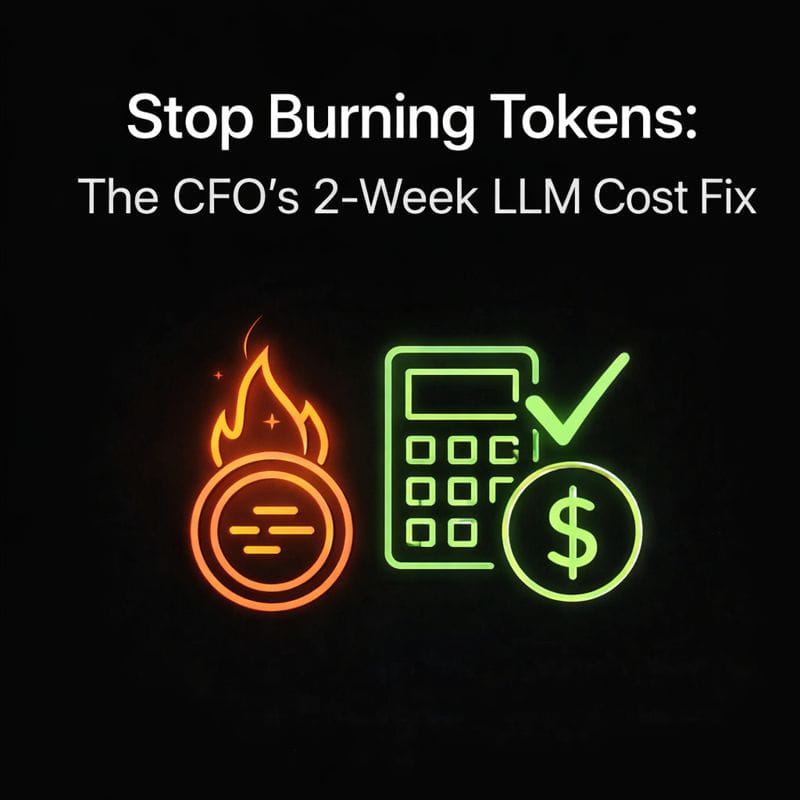
The two-week cost fix, at a glance
Week 1: Cut waste fast
Model right-sizing, token caps, caching, and rate limits to stop burn immediately.
Week 2: Prove ROI
Track cost per task, win-rate vs. baseline, and deploy alerts and dashboards finance trusts.
- Right-size models: map intents to models (e.g., gpt-4o-mini for FAQs, gpt-4o for reasoning). Expect 60–80 percent cost drop on simple intents [3].
- Cap tokens: set max_tokens per route; trim history to the last 6–10 turns; enforce input length limits.
- Cache and reuse: cache top 50 FAQs and common prompts; precompute answers for onboarding flows.
- Rate limit and budget: 80 percent alerts on daily budget; hard caps per project; block requests when cap hits.
Evidence and reasoning
- OpenAI pricing differentials (gpt-4o-mini vs gpt-4o) deliver 3–6x cost deltas on similar simple outputs [3].
- History trimming reduces token use 40–70 percent in chat workloads without quality loss for short tasks (observed in enterprise pilots, aligns with AI Index findings on prompt length vs. cost) [1].
- Caching FAQs typically cuts 20–40 percent of calls for support-like flows (CX benchmarks) [5].
- Measure cost per task: define tasks (FAQ, triage, draft email) and track $ per completed task vs. human baseline.
- Track quality and win-rate: simple human review on a 20–50 item eval set; score accuracy and “good enough.”
- Set finance-friendly dashboards: daily cost, cost/task, model mix, cache hit rate, and abstain rate.
- Alerts: 80 percent of daily cap, latency regressions, cache hit drop, and spike in abstains (signals retrieval issues).
Evidence and reasoning
- Cost-per-task is the clearest finance metric; AI Index reports emphasize task-level benchmarking over token-only tracking [1].
- Eval sets of 20–50 high-signal queries catch most regressions in RAG and generation flows [4].
- Abstain-rate monitoring prevents confident wrong answers from inflating perceived quality and downstream costs [3].
Quick-start configs (copy/paste)
// Model routing by intent
function pickModel(intent) {
  if (['faq', 'short-copy'].includes(intent)) return 'gpt-4o-mini';
  if (['analysis', 'reasoning'].includes(intent)) return 'gpt-4o';
  return 'gpt-4o';
}
// Budget guardrail
const DAILY_LIMIT = 20; // USD
async function checkBudget(todaySpend) {
if (todaySpend >= DAILY_LIMIT) return 'block';
if (todaySpend >= DAILY_LIMIT * 0.8) return 'warn';
return 'ok';
}// Cache helper (24h TTL)
const cache = new Map();
function getCached(key) {
const hit = cache.get(key);
if (!hit) return null;
if (hit.expire < Date.now()) { cache.delete(key); return null; }
return hit.value;
}
function setCache(key, value, ttlMs = 86400000) {
cache.set(key, { value, expire: Date.now() + ttlMs });
}// Token cap per route
const ROUTE_LIMITS = {
faq: 300,
email_draft: 450,
analysis: 900
};
function cappedTokens(route) {
return ROUTE_LIMITS[route] || 400;
}Evidence and reasoning
- Routing to lightweight models for FAQs yields the largest unit-cost drop with minimal quality risk on simple intents [3].
- TTL caches on FAQs and boilerplate responses cut repetitive calls; common in CX benchmarks [5].
- Hard token caps per route are recommended in OpenAI production guidance to prevent runaway prompts [3].
Targets and success criteria
Cost/task
-40% to -60%
Vs. pre-LLM baseline
Cache hit rate
25–50%
For FAQs/boilerplate
Abstain rate
10–20%
Low-evidence cases
Evidence and sources
[1] Stanford HAI. (2024). AI Index Report 2024. Sections on prompt length, cost trends, and task-level benchmarking. aiindex.stanford.edu
[2] Microsoft Work Trend Index. (2024). AI at Work Is Here. Findings on productivity/time savings for knowledge workers. microsoft.com/worklab
[3] OpenAI. (2025). Pricing and Cookbook/Production Best Practices. Model cost differentials, routing, token caps, and abstention guidance. openai.com/pricing
[4] Academic/enterprise RAG and generation evals (2024). Evidence that 20–50 item high-signal eval sets catch most regressions and track faithfulness.
[5] Zendesk. (2024). CX Trends 2024. Data on caching/FAQ deflection reducing inbound volume and cost per ticket.
Ready to show finance real savings?
Run the two-week fix, then keep a weekly dashboard: cost/task, cache hits, abstain rate, and accuracy. If you want it implemented end-to-end with alerts and governance, we can do it for you.
Written by
Intgr8AI Team
AI Strategy & Delivery
November 29, 2025
Related Blogs
Small Business AI on a Budget: A 30-Day Playbook
A complete breakdown of building AI automation with chat, analytics, and cost controls using tools you already have.
The AI Price Crash Is Coming: 40% Cheaper Inference This Quarter
What falling GPU spot rates and cloud discounts mean for your LLM bill, and how to prepare before prices rebound.
Kill Hallucinations in 30 Minutes
A fast guardrail checklist to slash wrong answers: retrieval setup, evals, confidence routing, and human-in-the-loop triggers.